Challenges of Regenerative Systems Design (Part 2 of 4)
The Invisible Architecture:
Understanding How Assumptions Shape What Becomes Possible
Part 1 established a deceptively simple idea: uncertainty is not a flaw in living systems. It is a consequence of interconnection. As relationships multiply, outcomes emerge through feedback, adaptation, and context rather than through linear prediction alone.
If that is true, then the next question is not how to eliminate uncertainty, but how different models attempt to understand it.
The answer lies in how models define reality. Every model draws boundaries around what it includes and excludes. Those boundaries create clarity, but they also determine what becomes visible and what disappears from view.
To understand why economics and ecology often see the same world differently, we must begin with the assumptions built into their models. Because before a model produces an answer, it determines what questions can be asked in the first place.
How a Discipline Defines a System Determines What It Can See
Examining How Assumptions Shape Perception
The way a discipline defines a system determines how it engages with uncertainty, what it can measure, and ultimately what it considers real. This goes deeper than methodology; it shapes how success, failure, responsibility, and even truth are interpreted within a system.
By comparing the underlying assumptions of ecology and economics, we can better understand not only what each model reveals, but also what each leaves out. This is not an argument that one methodology is right and the other wrong, but an opportunity to examine how a model’s design determines what it can perceive, what it measures, and how those measurements shape the systems built around them.
Every model begins with assumptions about how the world works. Those assumptions determine which relationships matter, which variables are measured, and how uncertainty is interpreted. The contrast between ecology and economics begins at this foundational level.
Divergent Starting Points: Scarcity vs. Interdependence
Examining the Assumptions We Begin With
Economics is commonly defined as the study of how individuals, businesses, and governments allocate scarce resources to satisfy unlimited wants. As a result, many economic models prioritize optimization, equilibrium, efficiency, and control within bounded systems.
Ecology, by contrast, is the study of relationships between organisms and their environments, including both living and nonliving systems. Ecological models begin from interdependence, feedback, and continual adaptation within open systems.
These starting assumptions shape how each discipline approaches uncertainty and instability.
Economics often begins with:
Scarcity
Bounded systems
Equilibrium
Optimization within constraints
Predictability and control
Ecology often begins with:
Interdependence
Open systems
Feedback loops
Adaptation through relationships
Uncertainty as inherent
The assumptions a discipline begins with determine what it notices, values, and seeks to optimize. Starting assumptions shape not only the model, but the meaning of outcomes within the system
What Is Measured Shapes What Is Created
Understanding How Metrics Become Outcomes
Starting assumptions influence how people behave within a system, often reinforcing the very patterns the model is designed to measure.
Economic models that begin with scarcity, competition, and optimization tend to reward efficiency, growth, and resource allocation. As institutions, businesses, and policymakers respond to these measurements, they often reinforce the assumptions that resources are limited, actors are independent, and success is achieved through maximizing individual outcomes. The model does not merely describe behavior; it helps shape it.
Similarly, ecological models that begin with interdependence, feedback, and adaptation direct attention toward relationships, resilience, and system health. By measuring connections between organisms, resources, and environmental conditions, they reinforce the understanding that long-term viability emerges from maintaining the quality of relationships within the system rather than maximizing any single output.
What a model assumes influences what it measures. What it measures influences how decisions are made. Over time, those decisions can reinforce the very patterns and outcomes the model was designed to predict.
In this way, economic models often reinforce:
Competition over cooperation
Optimization over resilience
Short-term efficiency over long-term viability
Control over adaptation
While ecological models tend to reinforce:
Interdependence over isolation
Resilience over optimization
Adaptation over control
Long-term system health over short-term outputs
The assumptions embedded in a model do not simply shape our understanding of a system; they influence how the system evolves.
What we measure becomes what we optimize, and what we optimize becomes what we create.
Different Relationships to Uncertainty and Instability
Designing for Stability or Designing for Viability
In economics, uncertainty has often been treated as a problem to reduce through controlled assumptions and stable variables. Instability is frequently interpreted as a deviation from equilibrium.
In ecology, uncertainty is accepted as a defining condition of living systems. Instability is not necessarily failure, but often feedback indicating that relationships within the system are shifting.
This creates a fundamental divergence:
Economic models often seek stability through control
Ecological models seek viability through adaptation.
These differences determine whether a system resists variability or learns from it.
Stability and viability are often treated as synonymous, but they describe fundamentally different conditions. Stability refers to the ability of a system to maintain a particular state or return to equilibrium after disturbance. Viability refers to the ability of a system to continue functioning over time despite changing conditions. A system can appear stable while becoming increasingly fragile if it cannot adapt to new circumstances. By contrast, living systems often remain viable precisely because they are capable of responding, learning, and reorganizing as conditions change. In this sense, long-term viability emerges not from resisting change, but from adapting to it.
Open vs. Closed Systems: A Question of Boundaries
Examining What Becomes External
Every model creates boundaries around what it includes and excludes. Those boundaries create analytical clarity, but they also constrain what the model can perceive. The boundaries of a model determine what counts as part of the system and what becomes external to it.
What each discipline can explain follows directly from how it defines those boundaries.
Ecology models systems as fundamentally open. In ecology:
Organisms are inseparable from their environments
Energy, matter, and information continuously flow across boundaries
Feedback loops regulate system behavior
Function emerges through relationships
No part can be fully understood in isolation because interconnection is not merely a feature of the system. Interconnection is the system.
Economics often models systems as comparatively closed. In many economic models:
Actors and markets are treated as isolated units
Value is defined within fixed accounting boundaries
Equilibrium is assumed as a stable endpoint
What falls outside the model becomes “external”
No system can be analyzed in its entirety, so economic models create boundaries that isolate variables in order to improve measurement, prediction, and control. The boundary does not remove the relationship; it determines whether the relationship becomes visible.
Where ecology begins with relationships and then studies the parts, economics often begins with the parts and then models their relationships. Ecology begins with permeability and feedback; economics often begins with isolation and control.
The critical question is not what lies inside the boundary, but what happens to relationships that remain essential after they are excluded from it? A company may treat labor costs as internal and family caregiving as external, yet caregiving continues to influence workforce participation, health, productivity, and long-term economic outcomes. The boundary changes the accounting, not the relationship. The same is true of ecological degradation, unpaid care work, social trust, and long-term systemic risk. These relationships continue to shape outcomes whether they are measured or not. Their exclusion may simplify analysis, but it does not remove their influence. Often their importance becomes visible only when accumulated effects emerge as a crisis.
What Each Model Can Reveal and Obscure
Balancing Precision and Relational Visibility
The way ecology and economics define systems determines which aspects of reality each is best equipped to understand.
Ecology treats systems as open and relational so it is well suited to understanding:
Resilience
Adaptation
Tipping points
Long-term system health
Cascading effects and feedback loops
A limitation of ecology is precision. Open systems are difficult to parameterize, making predictions probabilistic rather than exact.
Economics, by narrowing variables and simplifying relationships, excels at:
Price formation
Resource allocation
Transaction analysis
Short-term forecasting
Optimization within stable conditions
The limitation of economics is relational visibility. By reducing complexity, models may fail to capture cumulative impacts, delayed feedback, ecological degradation, and systemic fragility outside the accounting frame.
Ecology preserves relational accuracy but sacrifices precision; economics achieves precision by narrowing relational complexity.
This tradeoff is not inherently problematic. All models simplify. The challenge emerges when relationships excluded for analytical clarity continue to influence the system in material ways.
Comparing Dominant Modeling Tendencies in Ecology and Economics
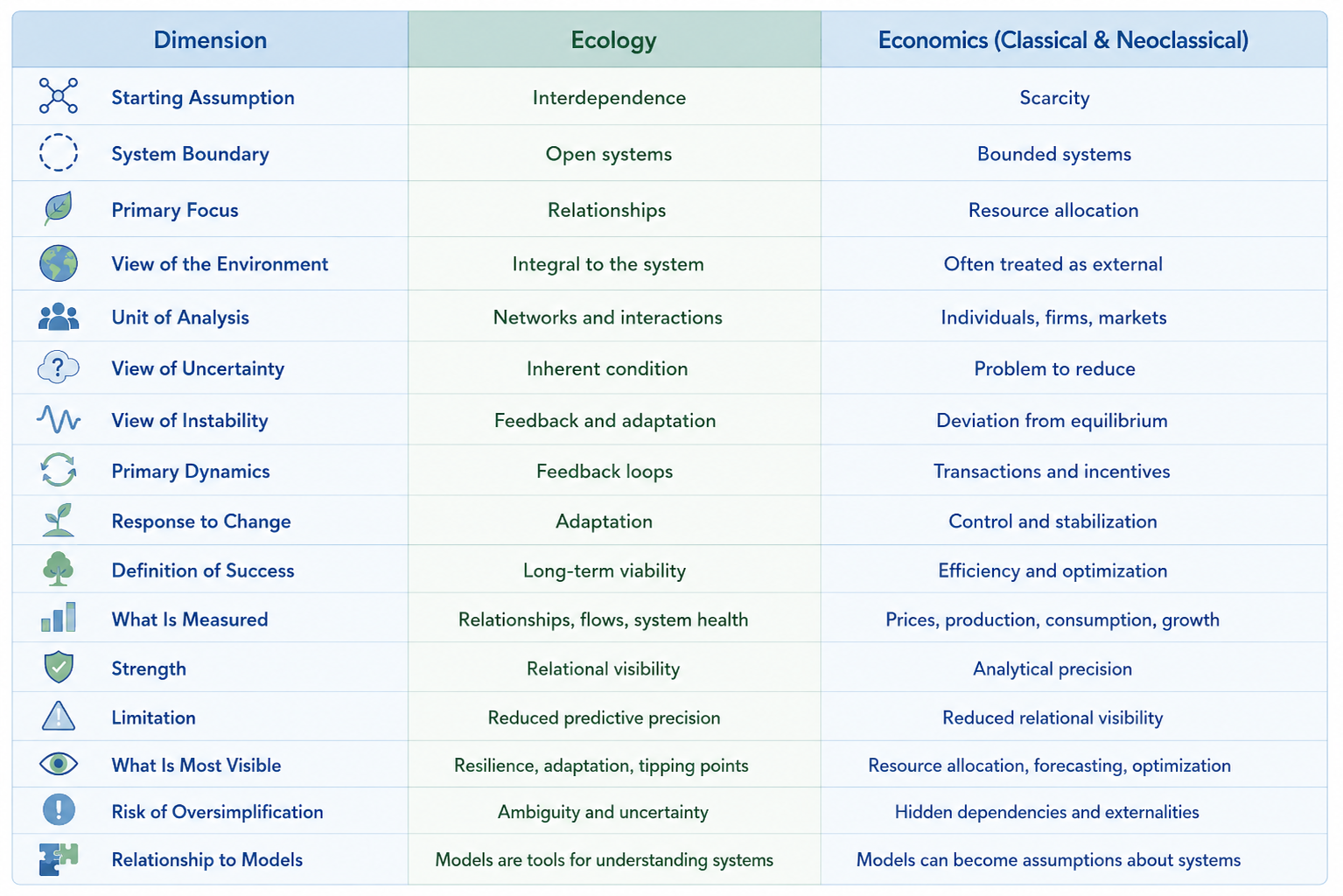
Ecology and economics often begin with different assumptions about how systems operate. These starting assumptions influence what each discipline measures, what it treats as relevant, and what kinds of questions it is best equipped to answer. The comparison highlights tradeoffs in visibility rather than superiority of one approach over another.
Boundaries Determine What Becomes Visible
Recognizing That Exclusion Is Not Absence
Boundaries are not merely analytical tools. They determine what the model recognizes as relevant, measurable, and real.
A tightly bounded model can generate clarity and predictive power within limited conditions, but what lies outside the boundary may still shape the system materially. When important relationships are excluded from the model, the system may appear stable while underlying risks continue to accumulate beyond view.
In real systems, boundaries are not lines of separation. They are zones of interaction where exchange, feedback, and constraint occur. Firms are not separate from ecosystems. Labor is not separate from social conditions. Markets are not separate from communities. Transactions are not separate from long-term consequences.
When these relationships fall outside a model’s accounting boundary, they are often treated not as integral system dynamics, but as externalities.
What a model excludes does not disappear from reality; it disappears only from the calculation.
The Critical Distinction: Isolation as Method vs. Assumption
Examining When Simplification Becomes Assumption
Ecology and economics both simplify complex systems through mathematical models, but they differ in how they interpret the limits of those simplifications.
In ecology, simplification is treated as a methodological tool used to study specific processes within a larger interconnected system. In economics, simplification can become structural, where the analytical boundary hardens into an implicit claim about how the system itself operates.
In ecology, the model is bounded but the system remains open. In economics, the model boundary can become the perceived reality.
Ecologists isolate variables in order to study complex interactions more clearly, but they explicitly define what is excluded, acknowledge uncertainty, and reintegrate findings back into broader system context. A population, nutrient cycle, or ecosystem process may be modeled separately, but the model is understood as one window into a larger living system.
Ecological models often include:
Nonlinear dynamics
Feedback loops
Sensitivity analysis
Error terms reflecting environmental variability
Stochastic variation and changing conditions
Models are treated as provisional tools for insight, not complete representations of reality. Reduction is used to study interdependence, not to deny it.
In many classical and neoclassical economic models, simplification often becomes structural. Models narrow complexity by isolating variables such as price, production, labor, and consumption in order to generate measurable forecasts and actionable calculations.
This narrowing serves an important function. It creates analytical clarity, allows institutions to coordinate decisions at scale, produces standardized metrics and forecasts, and makes systems more predictable and governable. Under stable and bounded conditions, these models can be highly effective for short-term coordination and optimization.
But this precision comes through reduction.
Many economic models assume:
Rational actors
Equilibrium-seeking systems
Fixed accounting boundaries
Limited external influence
Predictability through controlled assumptions
As complexity is reduced, uncertainty becomes easier to manage mathematically, but relational dynamics become harder to see. The more tightly bound the system, the easier it becomes to generate precise outputs, even if those outputs capture only a fragment of reality.
The difference is not whether simplification occurs. The difference is whether simplification remains a tool for understanding relationships or becomes an assumption about reality itself.
This distinction is not absolute. Several schools of economic thought have emerged in response to the limitations of highly simplified models. Fields such as ecological economics, complexity economics, behavioral economics, and institutional economics attempt to incorporate feedback loops, human behavior, environmental constraints, and systemic interdependence more explicitly into economic analysis.
These approaches recognize that economies do not operate independently of ecological systems, social institutions, or human behavior, but are embedded within them. Their emergence reflects a growing recognition that understanding complex systems may require models capable of accounting for more than transactions and market signals alone.
This brings us to the next question:
What happens when relationships that remain materially essential to a system are conceptually removed from the model?
Throughout this inquiry, a recurring pattern has emerged. The way a model defines a system determines what becomes visible within it. Assumptions shape measurements. Measurements shape decisions. And decisions, repeated over time, shape the systems themselves.
This does not mean simplification is wrong. All models simplify. The question is what happens when the relationships removed for analytical clarity continue to influence the system in material ways.
A farm does not stop depending on soil because a model excludes it. A community does not stop influencing economic outcomes because social trust is difficult to measure. An ecosystem does not stop imposing limits because those limits fall outside an accounting framework.
Reality continues to operate through relationships whether or not those relationships appear in the model. And when essential relationships disappear from the calculation, their consequences rarely disappear with them.
This brings us to one of the most consequential implications of model design. If important relationships are excluded from measurement, where do their costs go? If they disappear from the calculation but remain active within the system, what happens to the risks, dependencies, and feedback loops that have been pushed beyond the model's boundaries?
Part 3 examines the consequences of separation. It explores how relationships that disappear from the model often reappear as externalities, how those externalities accumulate as hidden costs, and how the exclusion of essential system relationships can transform apparent stability into systemic fragility. The article concludes by considering why we adhere to our current systems and what might support us in designing more regenerative structure for our long-term collective benefit.
2024 Leilani Vella. All rights reserved ©
Primary Sources:
Anderson, B., and A. McLellan. Ecological Economics and Systems Thinking: Foundations for Regenerative Design. 2019.
Bertalanffy, Ludwig von. General System Theory: Foundations, Development, Applications. George Braziller, 1968.
Capra, Fritjof. The Web of Life: A New Scientific Understanding of Living Systems. Anchor Books, 1996.
Costanza, Robert, Herman E. Daly, and John A. Bartholomew. “Goals, Agenda, and Policy Recommendations for Ecological Economics.” Ecological Economics, vol. 1, no. 1, 1991, pp. 1–20.
Daly, Herman E. Beyond Growth: The Economics of Sustainable Development. Beacon Press, 1996.
Daly, Herman E. Steady-State Economics. W. H. Freeman, 1977.
Daly, Herman E., and Joshua Farley. Ecological Economics: Principles and Applications. 2nd ed., Island Press, 2011.
Georgescu-Roegen, Nicholas. The Entropy Law and the Economic Process. Harvard University Press, 1971.
Keynes, John Maynard. The General Theory of Employment, Interest and Money. Macmillan, 1936.
Kimmerer, Robin Wall. Braiding Sweetgrass: Indigenous Wisdom, Scientific Knowledge, and the Teachings of Plants. Milkweed Editions, 2013.
Marshall, Alfred. Principles of Economics. Macmillan, 1890.
Meadows, Donella H. Leverage Points: Places to Intervene in a System. The Sustainability Institute, 1999.
Meadows, Donella H. Thinking in Systems: A Primer. Chelsea Green Publishing, 2008.
Odum, Eugene P., and Gary W. Barrett. Fundamentals of Ecology. 5th ed., Brooks/Cole, 2005.
Ostrom, Elinor. Governing the Commons: The Evolution of Institutions for Collective Action. Cambridge University Press, 1990.
Polanyi, Karl. The Great Transformation: The Political and Economic Origins of Our Time. Farrar & Rinehart, 1944.
Raworth, Kate. Doughnut Economics: Seven Ways to Think Like a 21st-Century Economist. Chelsea Green Publishing, 2017.
Simon, Herbert A. “The Architecture of Complexity.” Proceedings of the American Philosophical Society, vol. 106, no. 6, 1962, pp. 467–482.
Smith, Adam. An Inquiry into the Nature and Causes of the Wealth of Nations. W. Strahan and T. Cadell, 1776.
Trace One. “Grocery Store Items That Have Increased Most in Price.” Trace One.